Engineering consultancy for the spice industry

Microbially safe spices, without losing colour, aroma or taste.

We design, build and commission continuous steam sterilization systems and complete spice processing plants, and help existing factories run them better.

25+years in spice processing
20+years in steam sterilization
1,000 kg/hnominal chilli throughput per line
5-logreduction on E. coli & Salmonella

Trusted on sterilization projects by ofi (Olam Food Ingredients)

ChilliWhole & ground spicesSeeds & herbsParticles up to 10 mm
What we do

One engineering partner, from first drawing to full production.

Electrical and mechanical engineering know-how, applied specifically to spice processing. Whether you are building a new plant or fixing an existing line, we take responsibility for the outcome.

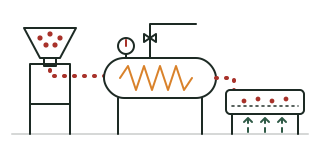
Illustration: spice moving from a feed hopper through a steam sterilizer into a fluid-bed cooler

Steam sterilization systems

Continuous, automated steam sterilizers built indigenously to your capacity and product mix, with the full upstream and downstream line.

  • Continuous & batch sterilizers
  • Automation and controls
  • Clean-room support to client spec
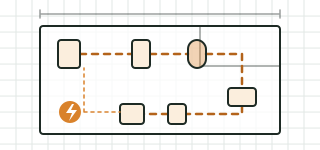
Illustration: plant layout drawing with process route and electrification

Turnkey plant engineering

Plant layout and electrification, equipment selection, budgeting, vendor management, erection and commissioning, handled end to end.

  • Plant design incl. electrification
  • Budgetary estimates & vendor PO
  • Erection & commissioning
Illustration: performance gauge moving into the green and output bars rising

Optimisation & troubleshooting

We study your current line, identify the bottlenecks and execute the fix, including support for sterilization units already installed.

  • Process improvement studies
  • Equipment replacement with guarantee
  • Indigenous spare parts
Flagship system

Continuous steam sterilization for chilli and spices

A short, high-temperature, high-pressure steam treatment that kills pathogens while the product itself never reaches damaging temperatures. Total plate count (TPC) is brought below the target set by your customer or regulator, with smell, taste and appearance preserved.

01

Controlled time & temperature

A first-in, first-out conveying system gives every particle the same residence time, around one minute, at the set temperature.

02

Gentle, homogeneous mixing

Product is mixed evenly and gently during treatment, so steam reaches every surface without damaging the material.

03

Condensation-free flash cooling

An immediate flow of dry, cool, filtered air in a fluidized bed thermally shocks surviving microbes and stabilises the product for safe packing. Final moisture is set by the program you choose.

How a line flows

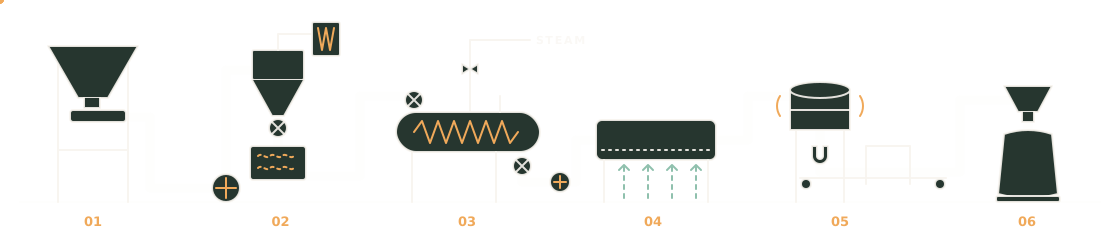
Diagram of a continuous steam sterilization line: feed, conveying and preheating, sterilizing, cooling and drying, safeguarding, and packing

Feed

Hoist, feed bin, vibratory bin, controlled feeder

Convey & preheat

Pneumatic conveying, bag filter, cyclone, preheater

Sterilize

Steam-locked rotary valves in and out of the sterilizer

Cool & dry

Delumper and fluidized bed dryer with chilled air

Safeguard

Vibrosifter screen, magnet, online metal detector

Pack

Bagging system, ready for dispatch

Full equipment list for a continuous sterilization line (21 items)
  1. Hoist
  2. Feed bin
  3. Vibratory bin
  4. Control feeder
  5. Pneumatic conveying (blower, bag filter, cyclone, rotary valve)
  6. Preheater
  7. Steam feed rotary valve
  8. Sterilizer
  9. Steam discharge rotary valve
  10. Delumper
  11. Fluidized bed dryer
  12. Rotary valve
  13. Pneumatic conveying (blower, bag filter, cyclone, rotary valve)
  14. Delumper
  15. Safety screen vibrosifter
  16. Magnet
  17. Online metal detector
  18. Bagging system
  19. Steam header & lines
  20. Chiller & lines
  21. Heat exchangers (hot & cold)
Project delivery

A clear path, whether you are starting fresh or upgrading.

We work alongside your project coordinator at every stage, so decisions stay with you and accountability stays with us.

Illustration: plant drawings becoming a new factory under construction
New plants

Greenfield projects

From concept to a running line.

  1. Plant designLayout, process flow and electrification
  2. Equipment selectionRight-sized for your products and capacity
  3. Budgetary estimateTransparent costing before you commit
  4. Vendor quotationsCollected and compared on your behalf
  5. Vendor finalisationAgreed jointly with your coordinator
  6. Purchase ordersReleased and tracked
  7. On-time deliveryExpediting and receipt of equipment
  8. Erection & commissioningInstalled, tested and handed over
Illustration: an existing factory being tuned up, with performance rising
Existing factories

Upgrades & troubleshooting

More output, fewer stoppages, from the line you already have.

  1. Process studyWe assess current conditions and problems, then recommend improvements
  2. ExecutionOnce approved, we carry out the modification
  3. Equipment replacementNew equipment with a performance guarantee
  4. SourcingIdentifying the right machine for a specific need
  5. Indigenous sparesLocally built spare components to cut lead time and cost
  6. Sterilizer supportPerformance tuning and troubleshooting for installed units
Equipment

Make-or-buy support for every machine in a spice factory.

We help you decide whether to build or source, specify it correctly and get it working on your line.

Conveying

Bucket elevators, screw and flat conveyors, pneumatic conveying systems

Dust & air

Bag filters (conventional and pleated), cyclones, rotary valves

Grinding

Hammer mills, pulverizers, universal mills, pin mills, roller mills

Cleaning & grading

Graders, destoners, bin vibrators, electrostatic rollers

Sifting & blending

Vibrosifters, blenders, roasters

Food safety

Magnetic separators, online and offline metal detectors

Sterilization

Batch and continuous steam sterilizers

Utilities

Steam headers, chillers, hot and cold heat exchangers

Need something not listed? If it belongs in a spice factory, we can help specify, source or build it.

From the field

Our work on the ground

Client recognition
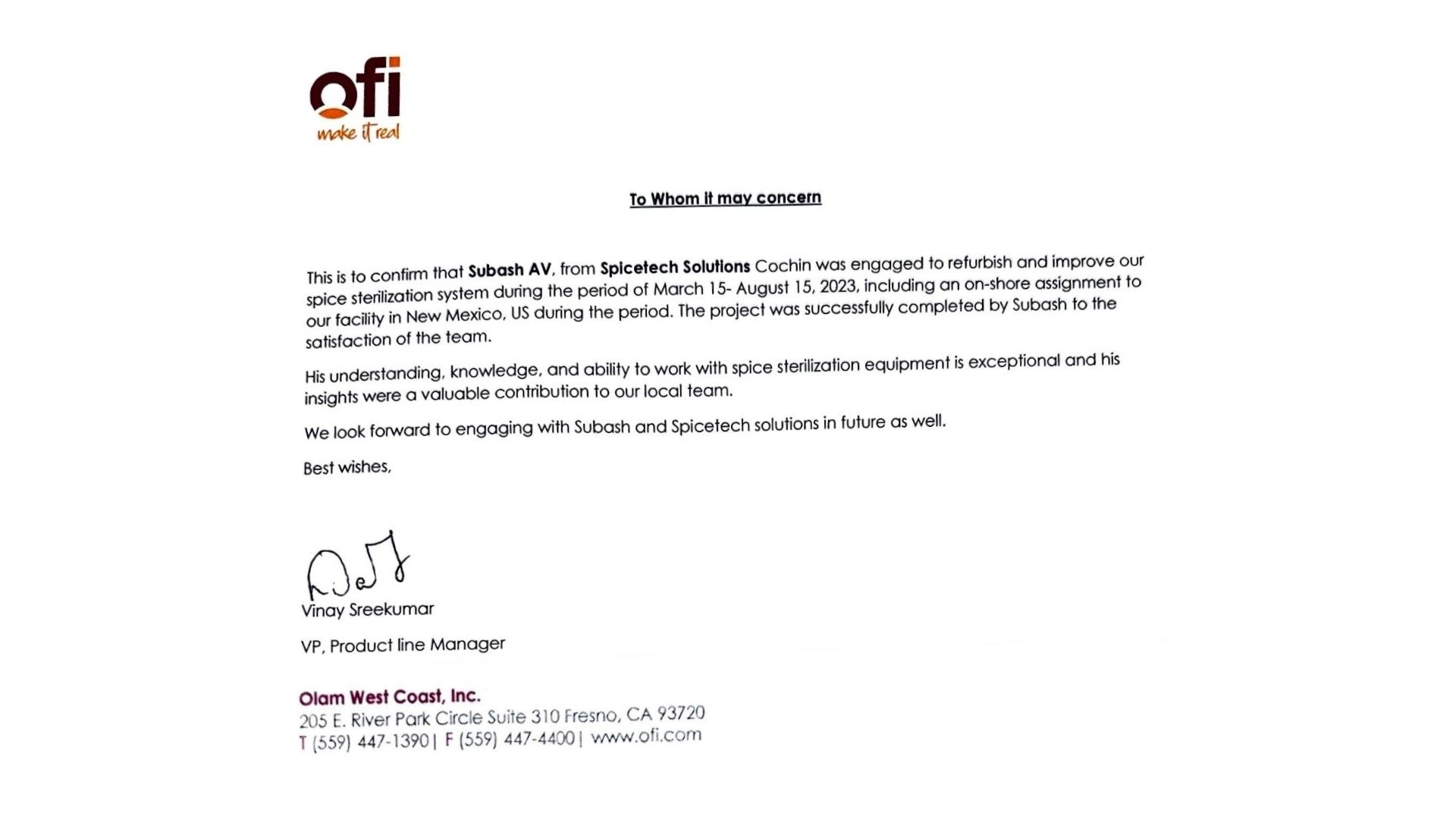
His understanding, knowledge, and ability to work with spice sterilization equipment is exceptional and his insights were a valuable contribution to our local team.
Vinay SreekumarVP, Product Line Manager · Olam West Coast, Inc. (ofi)
Reference letter from ofi (Olam West Coast, Inc.) for Spicetech SolutionsRead the full reference letterSigned, on ofi letterhead
Project snapshot

Sterilization system refurbishment for ofi, USA

Client
ofi (Olam Food Ingredients)
Where
ofi facility in New Mexico, USA (on-site assignment)
When
March to August 2023
Equipment
Raphanel spice steam sterilization system

What we did

  • Refurbished and improved the sterilization system
  • Established chamber pressure and consistent operation
  • Trained the local team to run the system
  • Planned peripheral improvements for full operational efficiency

“The project was successfully completed by Subash to the satisfaction of the team.”ofi reference letter

International clients

Working with clients outside India

We have delivered on site in the USA, and we take on projects wherever the plant is. This is how an overseas project runs.

01

Remote assessment

We start with a video call, your plant drawings, photos and product specification, and review the line or requirement before anyone travels.

02

Scope and plan

You get a clear scope, budgetary estimate and timeline, agreed with your project coordinator before you commit.

03

On-site work

We travel to your facility for installation, refurbishment, commissioning and operator training, as we did on ofi's sterilization project in New Mexico, USA.

04

Ongoing support

After handover we stay available by video call, email and WhatsApp for troubleshooting, tuning and spare parts.

Based in Kochi, India (IST, UTC+5:30). We schedule calls in your working hours, whether you are in the Americas, Europe, the Middle East or Asia.

Subash A V, Founder and Principal Engineering Consultant, Spicetech Solutions

Subash A V

Founder & Principal Engineering Consultant

25+
years in the spice processing industry
20+
years specialising in steam sterilization of spices
E&M
Electrical and mechanical engineering expertise
About Spicetech

Built on a career spent inside spice factories.

Spicetech Solutions is an independent engineering consultancy based in Kochi, Kerala, the heart of India's spice trade. We combine hands-on plant experience with electrical and mechanical engineering to help processors meet export-grade microbial standards and run efficient, reliable lines.

Specialist, not generalist

Spice processing and sterilization is all we do.

Indigenous build

Locally built systems and spares lower cost and lead time.

Vendor-neutral advice

We select equipment for your plant, not for a catalogue.

Guaranteed performance

Replacement equipment comes with a performance guarantee.

FAQ

Questions buyers ask about steam sterilization

Straight answers on how it works, what it does to your product, and how a project gets started.

What is steam sterilization of spices?

Spices are farm products and often carry bacteria, yeasts and moulds, including pathogens such as Salmonella. Steam sterilization exposes the product briefly to saturated steam under pressure, which kills these microbes, then cools and dries it straight away.

Done well, it brings the total plate count (TPC) down to the level your buyer or regulator requires while keeping the spice's colour, aroma and flavour.

Why steam rather than ethylene oxide (EtO) or irradiation?

Steam is a physical treatment that uses only water, so it leaves no chemical residue.

Ethylene oxide is not permitted for treating food in the European Union, and EtO residues have caused large recalls of spices and seeds in export markets. Irradiation is allowed in many countries, but irradiated food has to be labelled in major markets such as the EU and the US, and some buyers will not accept it. For exporters, steam is usually the treatment buyers are most comfortable with.

Will steam treatment change the colour, aroma or taste?

Any heat treatment can affect quality if it runs too long or too hot, so the process is built around short, controlled exposure. In a continuous system every particle gets the same residence time (about a minute in our reference chilli line), and flash cooling in a fluidized bed with dry, filtered air stops the heat immediately.

Temperature, time and moisture are set for each product to balance microbial reduction against quality.

What happens to moisture content?

Steam adds some moisture as it condenses on the product. The fluidized-bed stage after the sterilizer cools the product and dries it back down, and the final moisture is set by the drying program you choose, so the product is stable for packing.

Does steam sterilization kill bacterial spores?

Steam is very effective against vegetative bacteria such as Salmonella and E. coli; our reference line is designed for a 5-log reduction. Heat-resistant spores are harder to kill and may need a separate treatment regime. We advise on this during design.

Which products can be treated?

Chilli, whole and ground spices, seeds and herbs, in pieces up to about 10 mm. Products with very different particle sizes or oil contents may need different settings, which we work out during design.

What capacity can a line handle?

Our reference chilli line is rated at a nominal 1,000 kg/h and uses about 400 kg/h of steam at 8 kg/cm². Every line is engineered to the client's products and target throughput, so capacity is fixed during design.

Can you upgrade or fix a sterilizer we already have?

Yes. We study your existing line, recommend improvements and carry them out, including performance tuning, troubleshooting and locally built spare parts. For ofi in the USA, for example, we refurbished and improved an existing steam sterilization system on site.

Do you take on projects outside India?

Yes. We are based in Kochi, Kerala, and work wherever the plant is, including an on-site assignment at ofi's facility in New Mexico, USA.

How do we start a project?

Tell us your product, target capacity, the microbial specification you need to meet and where the plant is. We will discuss the right approach with you and, for a new line, prepare a budgetary estimate before you commit.

Contact

Tell us about your plant.

Share your product, target capacity and current challenge. We usually respond within one working day. We are on India time (IST, UTC+5:30) and schedule calls to suit your working hours.

Chat on WhatsApp Open in Maps